Mercedes Power Play: Why McLaren, Alpine, and Williams are the “Big Winners”

As the Formula 1 paddock arrives at Australian Grand Prix this year, the focus shifts to more than chassis upgrades. Rather, the focus is on the powertrain reset driven by the F1 regulations.
For the first time since 2014, the hierarchy around the Mercedes F1 Engine Power Unit. According to early test data, Mercedes-AMG High Performance Powertrains has adapted at full tilt. As a result, the Melbourne opener can reveal an absolute edge.
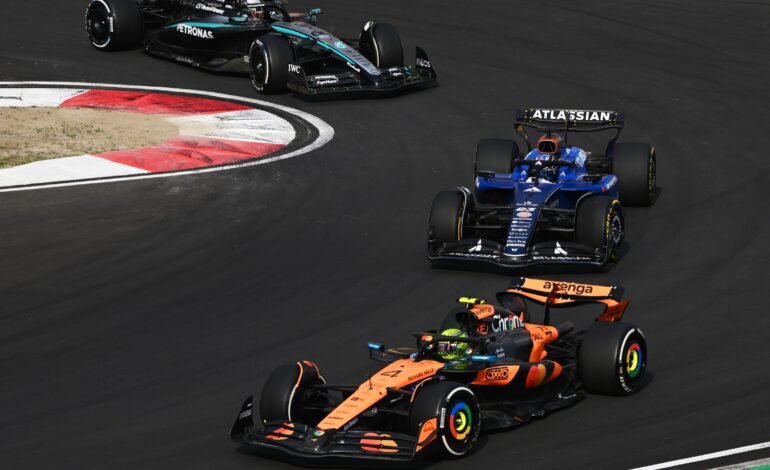
Though it is the Mercedes team that is going to benefit. This creates a deeper narrative for the three clients of Mercedes trio, namely McLaren, Williams Racing, and Alpine F1 Team. Together, they constitute what the insider named the Mercedes Triple Threat.
Mercedes: The Technical Framework
The F1 regulations remove the MGU-H and redirect the system to electrical usage. In particular, the sport requires a 50/50 split between electrical system and the Internal Combustion Engine.
- ICE power drops from apprx 850 bhp to about 540 bhp.
- The electrical output increases to 120 kW to 350 kW, about 470 bhp.
As a result, energy management moves from supporting aspect to a performance factor. Teams should avoid clipping, that is, the battery runs out before the straight ends.
The spec Mercedes Power Unit, internally named M17 E Performance, has shown strong recovery rates. Specifically, it retains charge further into long acceleration zones. Thus, it defends the top speed in such circuits as Albert Park.
In the F1 Engine Homologation, the manufacturers must lock their core architecture early. That hurdle, however, has not restricted Mercedes’ efficiency gains.
The Customer Parity: F1 Engine Homologation Level
Appendix 4 of F1 Engine Homologation regulations enforces parity. Customer teams should receive the exact hardware and software mapping as the works outfit.
That is, the same race-spec Mercedes Power Unit is used by McLaren, Williams and Alpine.
During the pre-season testing, Mercedes F1 Engine reportedly used conservative mapping in the durability tests. Nevertheless, the complete race definition comes out in Melbourne. This implies that customer cars gain access to optimised deployment modes and calibration.
The so-called 18:1 compression plan has elicited paddock debate. Despite that, the FIA has passed the unit for the opening rounds. Until now, Mercedes and its partners function within homologated boundaries.
The Beneficiaries: An In-depth Analysis
McLaren F1: Stability Becomes a Weapon
McLaren F1 is a title competitor after a successful 2025 campaign. Notably, the team has prevented interference with the suppliers and prolonged its cooperation with Mercedes until 2030.
Team principal Andrea Stella has defined the integration as smooth. Consequently, McLaren can combine aerodynamic stability and predictable deployment curves.
At Albert Park, there are traction zones that reward clean electrical delivery. Thus, McLaren would be able to turn defensive consistency into an attacking speed.
Alpine: The Strategic Layout
The Alpine Mercedes deal transformed this year. Alpine terminated its Renault engine project and entered into a multi-year supply agreement.
Due to this change, Alpine is aligned with front running architecture after several years. Initial simulation results indicate a gain of up to four tenths per lap.
For a team that was deficient in straight-line speed, the standardised Mercedes Power Unit provides a quantifiable advantage. As a result, Alpine re-enters upper-midfield calculations.
Williams: The Long-Term Revival
Williams Racing is an extended rebuild arc. Under James Vowles, the team integrated the power unit into chassis packaging.
Williams has historically fought drag inefficiency. However, the increased torque-fill of the new electrical system balanced the aerodynamic loss.
Practically, high exit acceleration means that exposure on long straights is less. Thus, the points finishes in Melbourne move from aspiration to a realistic goal.
The Compression Ratio
The regulatory resets often attract controversy. Further, competing teams such as Scuderia Ferrari and Red Bull Racing have suspected Mercedes interpretation of compression limits.
Reports detect scrutiny around thermal thresholds. New FIA temperature tests will be enforced later in the season. Yet, officials have passed the Melbourne specification.
As things stand, Mercedes and its units retain a short-term window of opportunity before check intensifies.
The Verdict for Australia
The Australian Grand Prix will confirm early projections. In case the Mercedes-powered car engines prevail at speed traps. Eventually, the competitive order may change.
In the case of McLaren F1, the goal is long-term championship pressure. Whereas, for Alpine, the Alpine Mercedes deal is a credibility restorative. For Williams Racing, the stable deployment under the new F1 regulations is an indicator of structural improvement.
Finally, the Melbourne round is the test of existence. Providing success, the Mercedes platform can serve as the first step of the age. Get more trends on Khelo24race and news on Mercedes F1 Engine.
FAQs
- Will Alpine genuinely have a Mercedes engine in 2026?
Yeah. After the Renault works engine program at Viry-Chatillon came to an end, Alpine signed a multi-year deal to utilise Mercedes F1 Engine power units and transmissions starting with the season.
- How different are the F1 engines?
With 100 per cent sustainable fuels, the new engines drop the MGU-H, increase electrical power to 350kW, and aim for 50/50 power distribution between battery and ICE.
- McLaren get the same engine as the Mercedes works team?
According to FIA rules, the customer teams (McLaren, Williams, Alpine) employ the same engine hardware and software mapping as the producer.
- In F1, what is the idea of clipping?
Clipping occurs when a vehicle has used all the deployable electric power before reaching the end of a straightaway and top speed drops suddenly. Good energy recovery helps us to avoid this.
- Who is the top contender in the Australian Grand Prix?
Although Red Bull is still a tough competitor, the Mercedes-powered teams (Mercedes, McLaren, Alpine) have proven to be superior in energy distribution throughout pre-season testing and are therefore the favorites in Albert Park’s high-speed circuit.